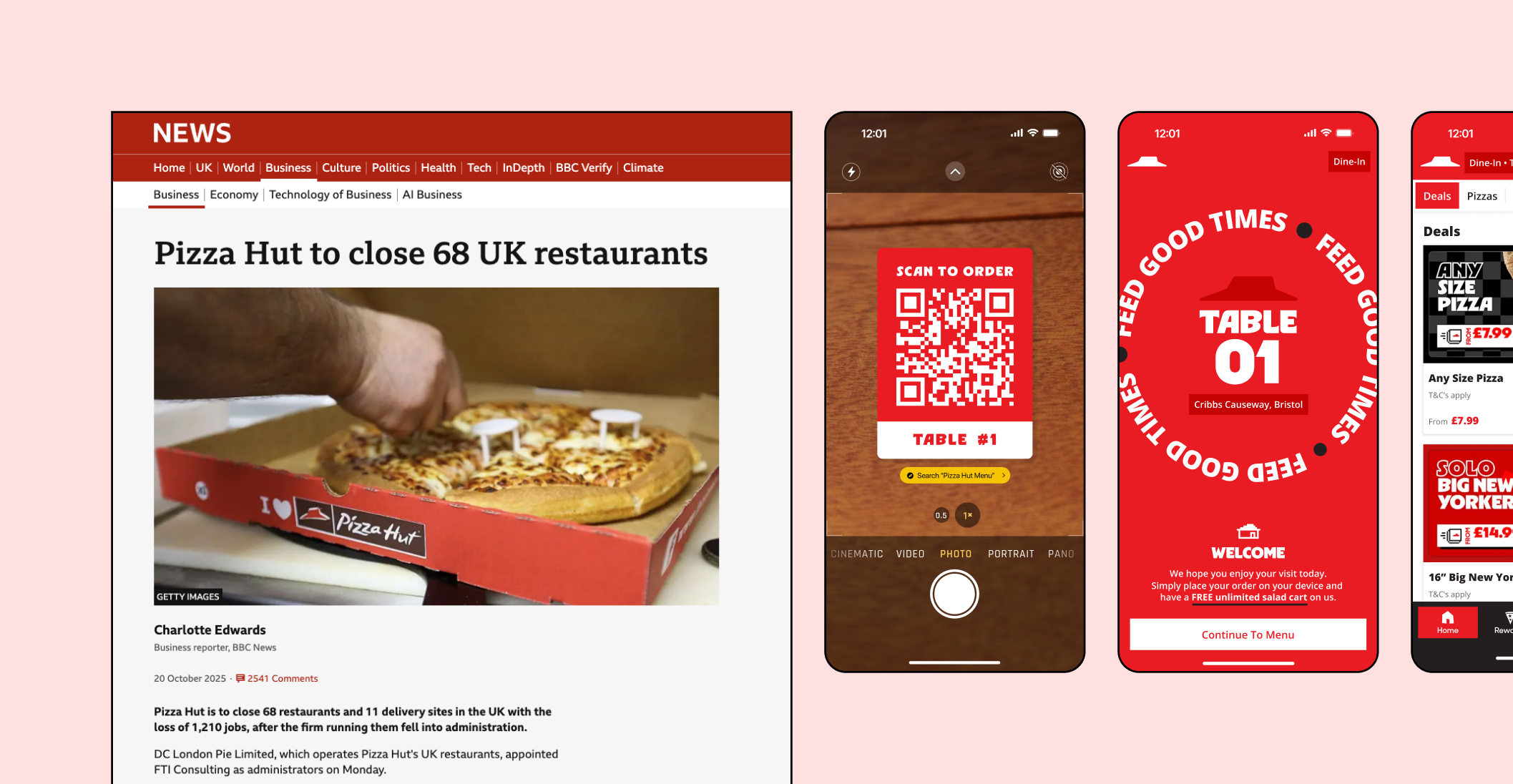
This page is optimised for desktop viewing
·
This page is optimised for desktop viewing ·
Designing an optimised digital dine-in experience
Role - Product Designer @ Pizza Hut Digital
Platform - Web and App
Scope - Repurposing the platform offering for dine-in operations
Team - PM, Tech-lead/architect, CRO
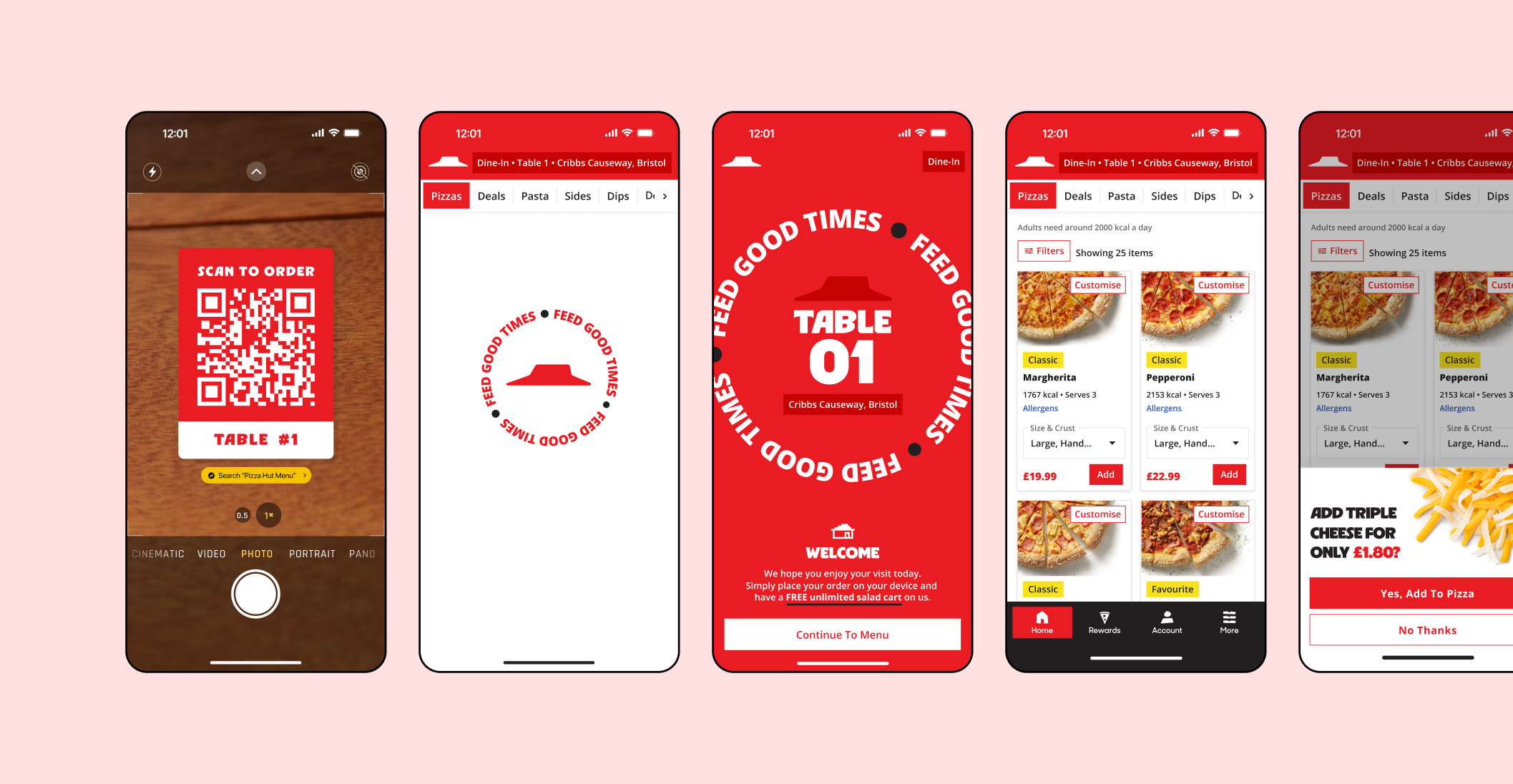
*View this image in more detail by clicking on it.
Summary
Following the successful Q1 2025 launch of Pizza Hut Digital’s e-commerce platform within the UK market, the restaurant-tech division sought to migrate their dine-in experiences onto this internal tech stack.
Operating as the lead designer within a dedicated product-discovery squad, I was responsible for the high-level scoping and definition of a 'Bring Your Own Device' (BYOD) experience. The primary objective was to leverage existing e-commerce design patterns to ensure cross-channel consistency, intentionally mitigating design debt by replacing opinion-led requests with evidence-based, scaleable solutions.
Problem
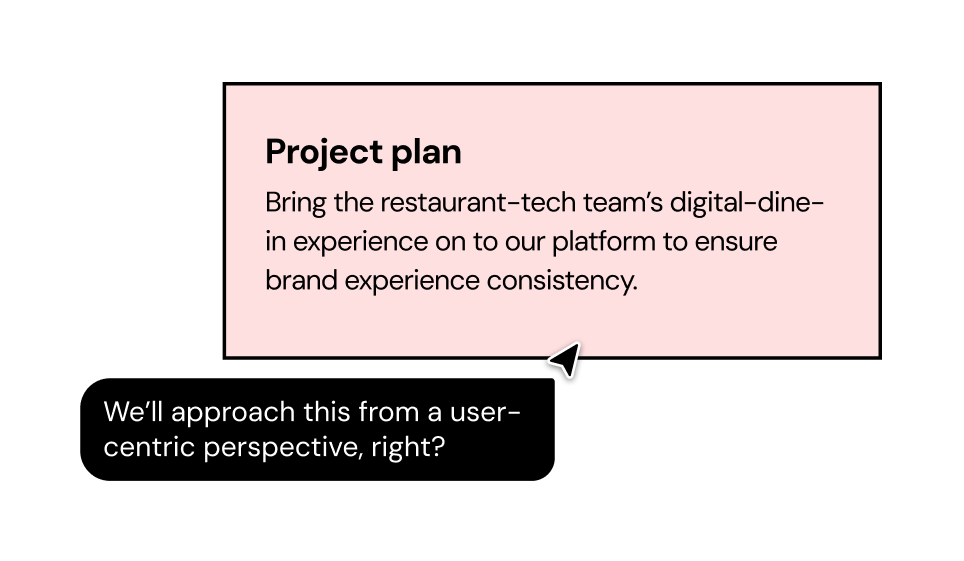
From a systems perspective, the existing restaurant infrastructure was a silo. Customers could earn-and-burn loyalty points online but hit a 'dead-end' when attempting to perform similar actions within a restaurant.
My objective was to identify high-impact dine-in use cases that could serve as blueprints for future e-commerce functionality and unify the pizza purchasing experience for Pizza Hut customers.
My role
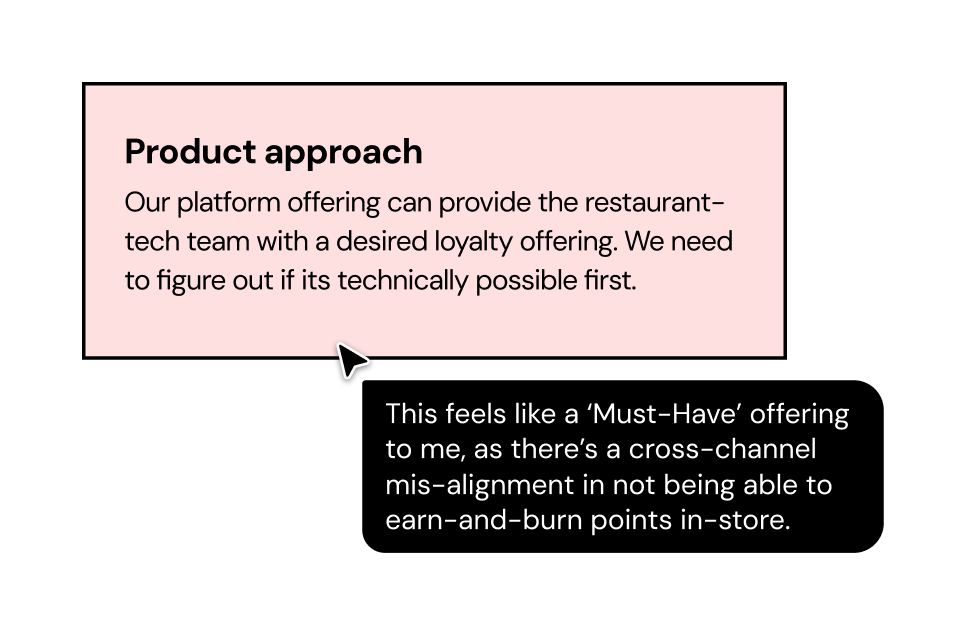
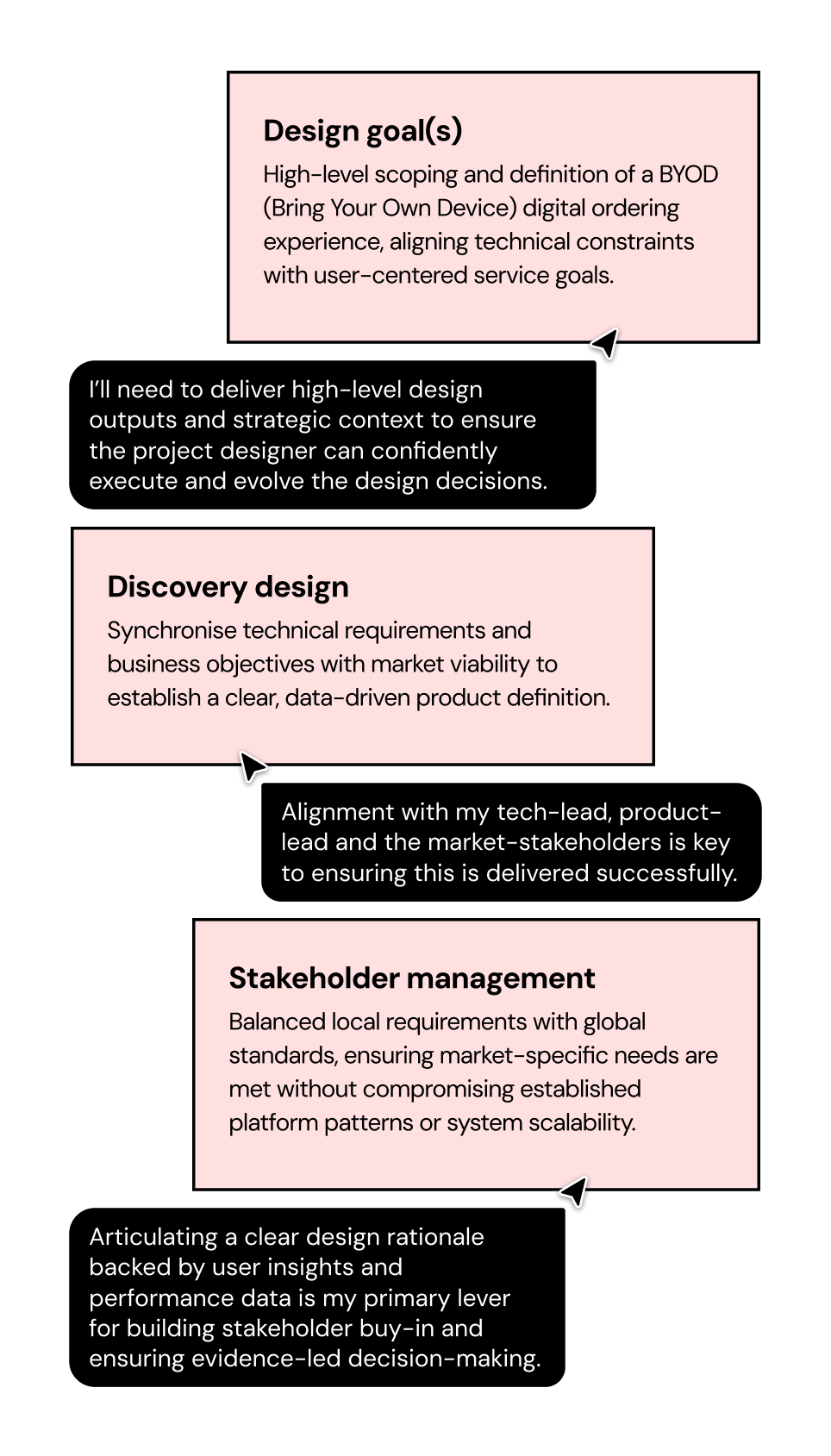
Tasked with the scope and definition of Pizza Hut’s bring-your-own-device experience from a high-level, I performed the following actions…
Design analysis - Mapping the end-to-end service and performing a competitive landscape analysis to understand key pain-points and product-opportunities.
Design discovery - Developed and implemented a targeted research strategy to stress-test and validate core stakeholder assumptions.
Stakeholder management - Acted as the lead design advocate for the project that navigated complex stakeholder discussions to safeguard the integrity of the user experience.
Product mindset - Led the definition of a high-impact MVP that strategically prioritised core functionality to ensure a lean, rapid market entry that would incrementally adopt new features.
My goal was to provide high-impact, lightweight design assets that streamlined the handoff process. By defining core interaction patterns and edge cases early, I would enable the development team to move at pace, fostering a truly agile environment where design was a facilitator of speed rather than a bottleneck.
Approach
Mapping the existing experience
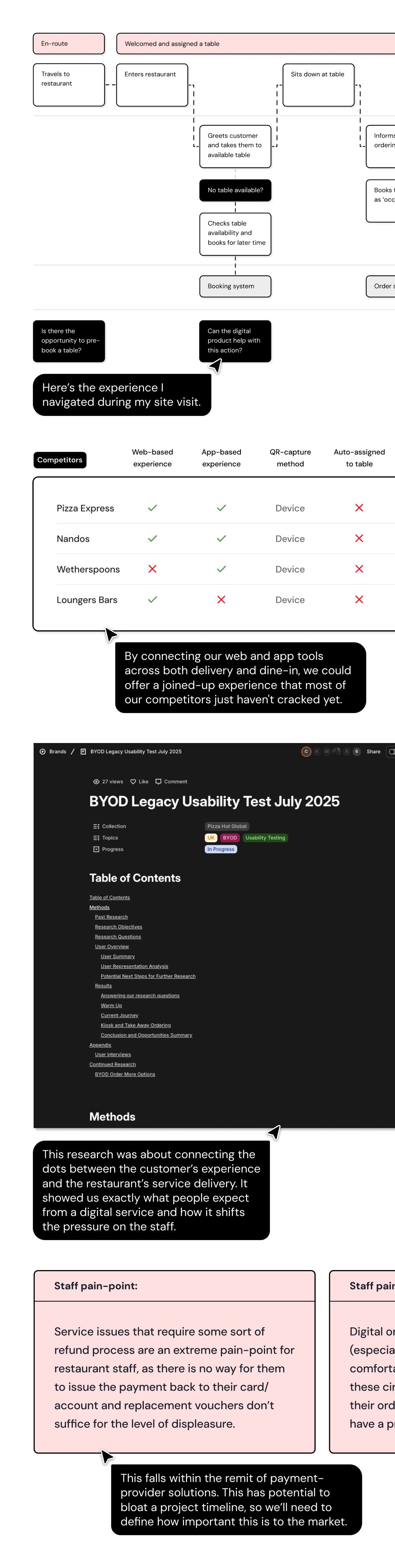
I conducted a contextual inquiry at a live site to audit the ‘digital-only’ ordering service. Immersing myself in the physical environment allowed me to map the end-to-end service journey from a customer’s perspective, identifying critical touch-points and friction areas that purely digital analytics might miss.
Key observation…
Limited payment options - The existing payment architecture forces a 'pay-before-prepare' constraint with no alternative to manual card entry provided. This reliance on legacy input methods—rather than seamless digital wallet integration—introduces unnecessary friction into the guest experience and highlights a clear opportunity for optimisation through modern payment APIs.
Analysing competitor offerings
To ensure our product was market-competitive, I audited high-performing digital dine-in experiences to pinpoint where the current offering was potentially lagging behind. These insights were then used to facilitate structured discovery conversations, testing specific value propositions with customers to determine which 'missing' features would drive the highest engagement.
Key-findings…
Product opportunities - A competitive audit revealed a fragmented landscape: while some players like Pizza Hut offer both native and web-based journeys, many competitors lacked a cohesive cross-platform strategy. This represented a significant opportunity to differentiate the experience by delivering a high-performance cross-channel experience that fits in with the users and their current interactions with the brand.
Loyalty is a key differentiator - Market analysis revealed that Pizza Hut Express is currently the only competitor with an integrated loyalty offering. By Pizza Hut aiming to scale this across both digital and dine-in channels, there is a unique opportunity to achieve a 'total ecosystem experience'—positioning the brand as the market leader in cross-channel customer retention and creating a significant barrier to entry for competitors.
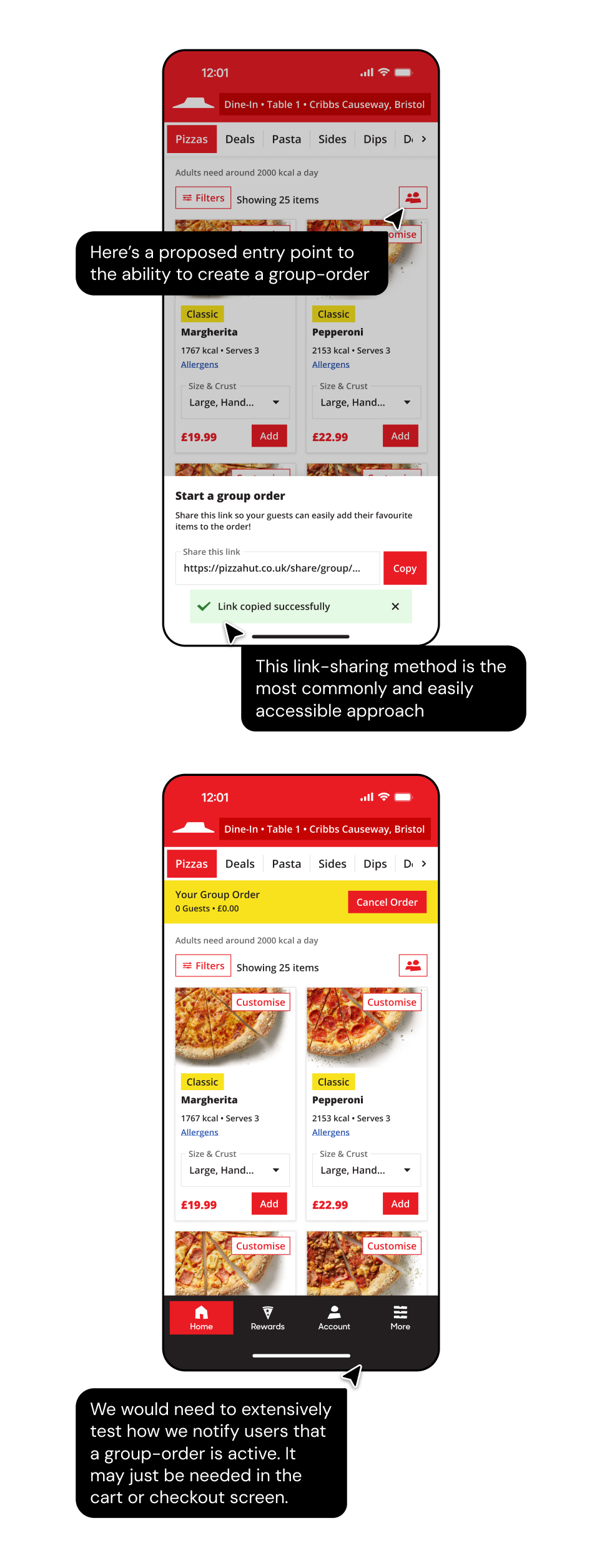
Split payments and group-ordering - While split payments and comprehensive group ordering were absent from our direct competitors’ dine-in offerings, these patterns are well-established in adjacent industries. I identified this as a clear opportunity for market differentiation. To validate the demand for these features, I proposed a series of high-fidelity prototype tests to determine if solving these specific friction points would drive higher adoption and average order value.
Research activities
I translated our high-level business goals and competitive gaps into a targeted research strategy. Partnering closely with a research-practitioner, I developed a plan to interrogate our existing service blueprint from a user-centric lens. This allowed us to move beyond anecdotal evidence and evolve our journey map into a data-backed roadmap for the dine-in experience.
Activities conducted…
Visiting restaurants with customers - I led a series of contextual inquiries across multiple UK locations, observing real-world user behavior in high-traffic restaurant environments. By pairing exploratory interviews with direct observation, I was able to pin-point exactly where the digital journey diverged from user expectations. This field research was critical in identifying environmental friction points—such as network connectivity and physical hardware constraints—that lab testing would have missed.
Conversations restaurant staff - By conducting interviews with restaurant managers and shadowing front-of-house teams, I audited the 'backstage' impact of digital ordering. This allowed me to map operational workflows and identify how the digital-first shift introduced new pressures into their daily routines. Taking this holistic view, I refined the service design to bolster staff efficiency, ensuring that customer-facing technology facilitated rather than hindered the physical service experience.
Key take-aways…
Loyalty expectations - The disparity between the online and dine-in ecosystems created a fragmented user experience. Customers with established digital profiles faced a 'broken loop' when they realised their loyalty data and app-instances were siloed from the restaurant environment. I identified this lack of cross-channel parity as a primary friction point, where the operational and visual inconsistencies failed to meet the expectations of an increasingly omni-channel audience.
Staff pressures - Feedback from site management highlighted a significant disconnect between the digital ordering stack and physical operational needs. The lack of an integrated refund or reversal process meant that staff were unable to provide satisfactory service recovery for guest complaints. This 'rigid' digital architecture forced a one-size-fits-all approach (gift cards) that failed to account for negative user sentiment, representing a major friction point in the end-to-end service delivery.
Influencing stakeholders
Product and engineering
The project faced internal pressure to de-scope the native app and loyalty features in favour of a leaner, faster market entry that would deliver existing experience parity.
Using the research findings as my primary lever, I challenged the lean product approach in the following ways…
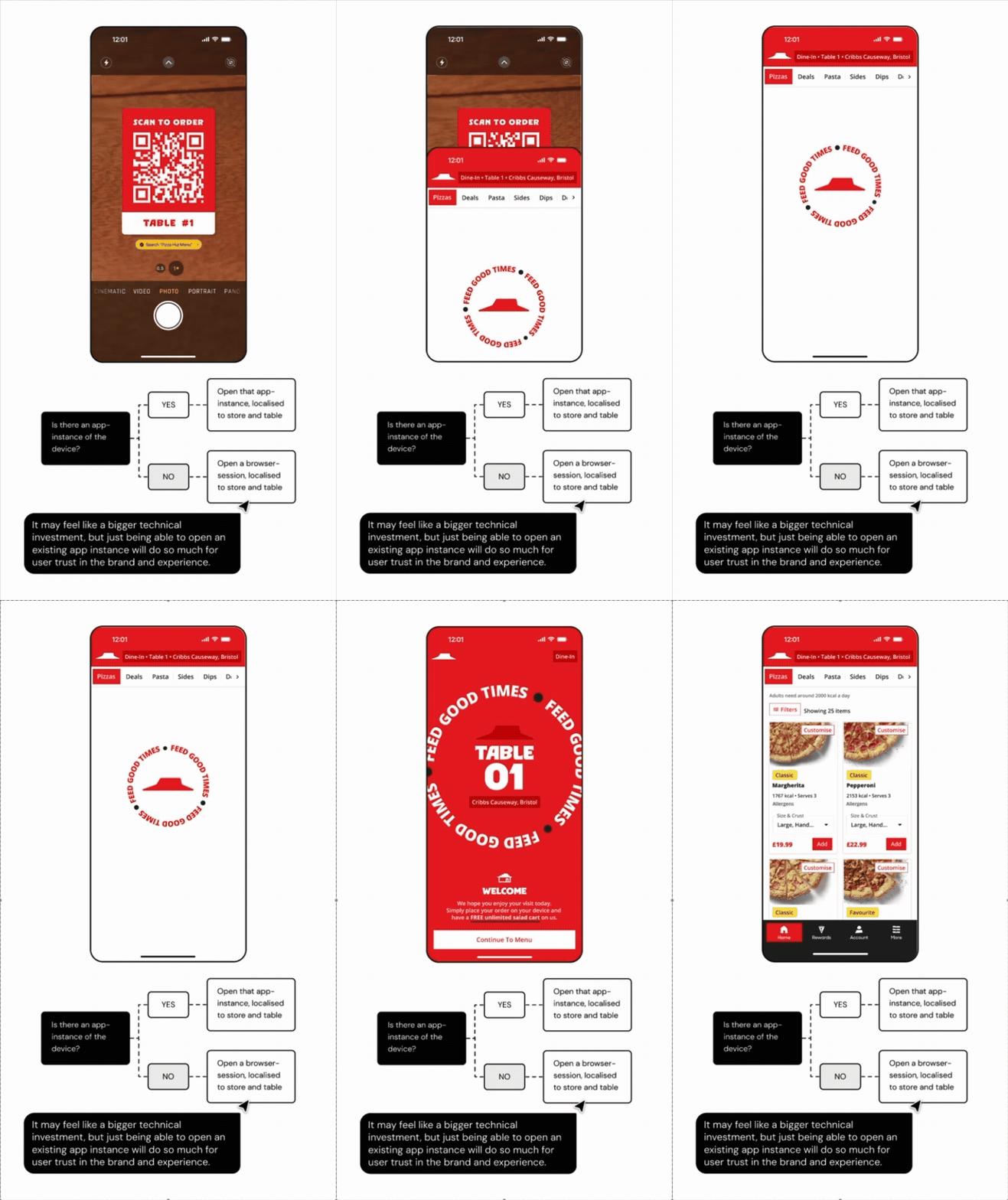
The native-app experience - I advocated for a unified native app strategy to maintain channel parity for our most invested customers. Recognising that a separate web-based dine-in journey would disrupt the user’s mental model, I surfaced evidence-based insights to pivot the team away from a 'web-only' constraint. This ensured we protected the brand experience and avoided alienating a high-value user base.
Loyalty offering expectations - Understanding that a full loyalty redemption experience would compromise our launch timelines, I facilitated a strategic compromise: an 'earn-only' approach for the first-release. This allowed the experience to meet the core user expectation of value-accrual while keeping the technical scope manageable for the initial release—de-risking the project without sacrificing long-term customer retention.
The market
It was confirmed that the delivery of an integrated app and loyalty experience was a primary value-driver for the market—a critical capability that they hoped the platform migration would unlock.
To align the team on a long-term vision, I presented 'North Star' prototypes for group-ordering and bill-splitting. This allowed us to pressure-test the strategic appetite for these features against the realities of our current operational infrastructure.
Feedback included…
Operational limitations - While user appetite for collaborative ordering was high, a technical gap analysis confirmed that these features belonged within the domain of core payment-integrations. Proceeding with a UI-only solution would have introduced operational misalignments between the digital storefront and the physical restaurant workflow. As a result of this, I collaborated with the product team to place these on a future roadmap, prioritising a stable and secure MVP over high-complexity outliers.
Market requirements
Concerns
A key concern the restaurant-tech and restaurant operations team held concerns over the platform’s handling of upsell interation patterns. The platform was designed to handle these opportunities within the basket/cart, with a passive-approach that didn’t interject the users’ typical order construction flow.
With this digital experience removing the ability for their restaurant staff to recommend and prompt these options to the user whilst they took their order, the market felt this would present a key risk to their average order values.
Mitigating risk
While legacy e-commerce data suggested that 'upsell interruptions' negatively impacted conversion rates, I recognized that the dine-in context presented a fundamentally different user intent than standard home delivery. I advocated for a series of A/B tests within the live environment to re-evaluate these patterns. My hypothesis was that, in a restaurant setting, targeted upsells function as a service enhancement rather than a friction point—potentially increasing average order value (AOV) without compromising completion rates."
Key tests included…
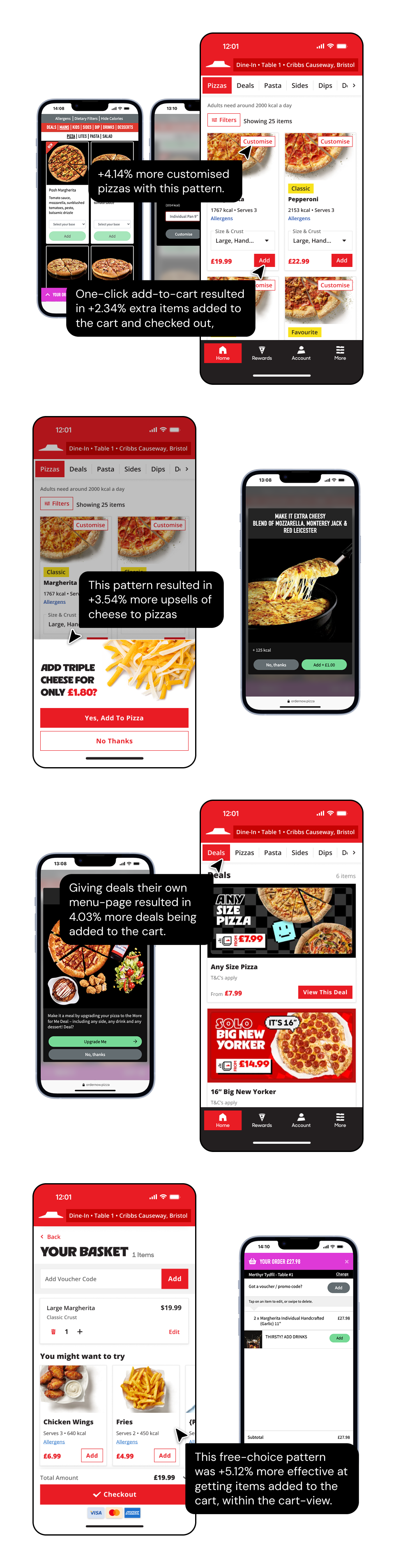
Cheese upsells - The existing experience utilised a disruptive modal pattern to prompt these modifications immediately upon adding a pizza to the basket. While current performance was suboptimal, I identified this as a high-potential interaction that required refinement rather than removal. My goal was to transition this from a 'hard interruption' to a seamless, context-aware prompt that potentially benefit the online ordering experience.
Deal upsells - Users were being subjected to back-to-back modal interruptions, first for cheese modifications and then for meal-deal conversions. This 'stacking' of prompts disrupted the user’s primary task-flow and increased the risk of funnel abandonment. I wanted to test if this pattern was more a symptom of poor menu discoverability, rather than a proactive service enhancement.
Pizza customisations - I flagged the low discoverability of the pizza customisation functionality within the existing dine-in interface as a missed opportunity for conversion. Drawing on the proven success of our online e-commerce patterns. I wanted to test how the surfacing these customisation entry-points would potentially impact the users’ perception of its value and the final transaction total.
Outcomes
The results of our live-market testing provided a clear mandate: our established e-commerce design patterns significantly outperformed the legacy market-specific interactions.
Key results included…
Cheese upsells - The results were definitive: this pattern drove a +4.23% increase in average order value (AOV) within the online ordering experience. Consequently, the functionality was prioritised for full-scale development and integrated into the core product offering as a high-impact design standard.
Deal upsells - The data validated my hypothesis regarding the platform's information architecture: introducing a dedicated 'Deals' category within the primary navigation prompted a +3.76% uplift in bundle sales. This significantly outperformed the legacy modal-driven approach, proving that a structured, discovery-led hierarchy is more effective for conversion than interruptive UI patterns.
Pizza customisations - By increasing the discoverability of customisation entry-points within the product-card, a +4.14% uplift in average order totals was achieved. This data validated the hypothesis that surfacing modifiers at the 'point of selection'—rather than burying them within the UI—directly correlates with increased basket size and user engagement.
Utilising live-product testing as a validation framework allowed me to challenge existing operational assumptions with hard data. This comparative visibility was instrumental in securing market buy-in for new interaction patterns that initially faced internal resistance. Without these data points, the project likely would have defaulted to a 'status-quo' parity product; instead, a measurably superior experience that maximised both user value and commercial uplift was defined.
Handover delivery
Definition and guidance
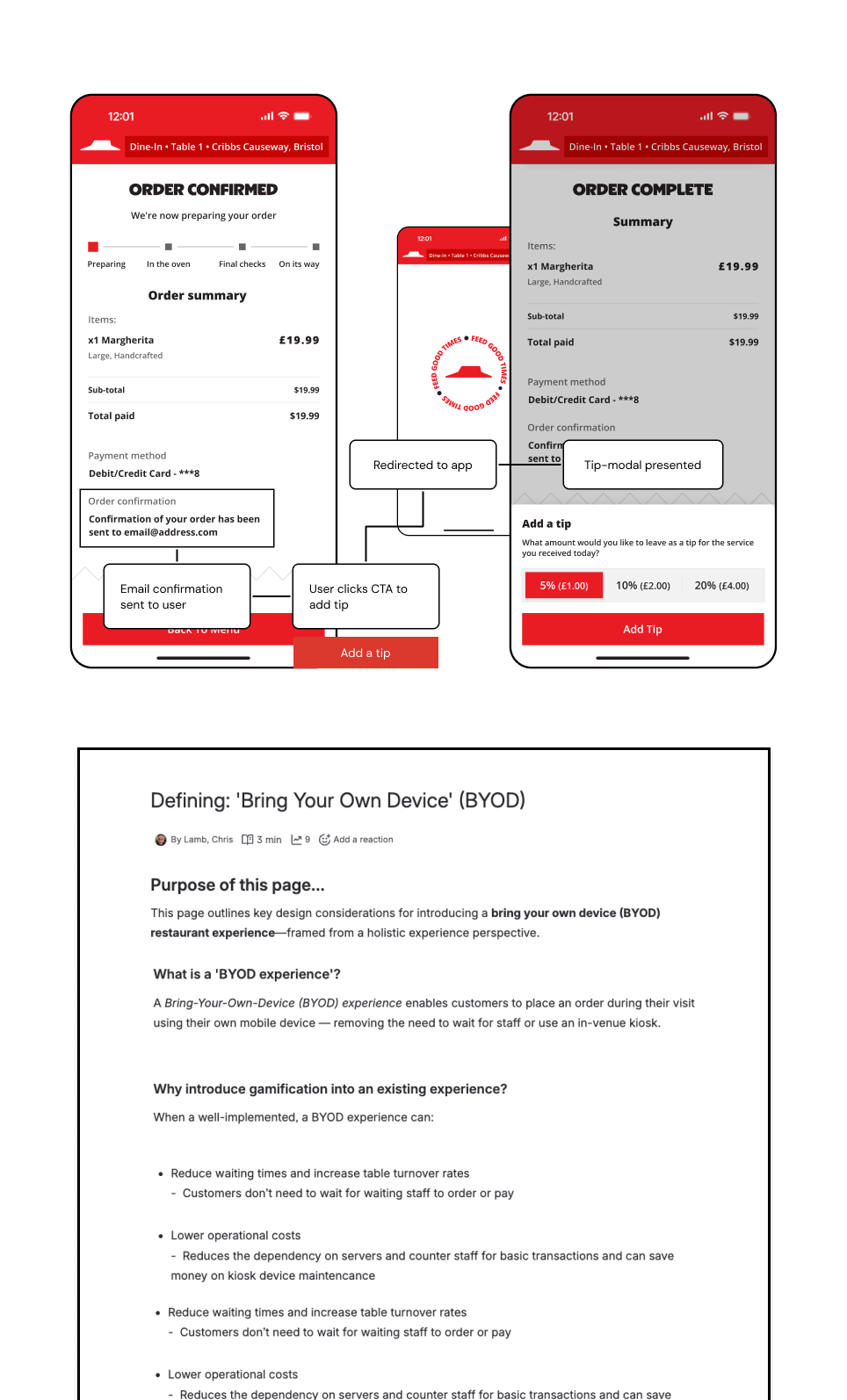
Once the strategic direction was validated, I collaborated with the Product Lead to formalise our findings into a Product Requirements Document (PRD). This served as the primary technical bridge, allowing the project team to ingest design specifications and functional constraints before moving into the planning phase. This proactive alignment minimised downstream ambiguity and ensured the 'North Star' features were accurately scoped for delivery.
As part of this document, I provided the following definitions…
Requirements and features - I led the definition of functional requirements, categorising features into platform-native adoptions versus custom builds. By identifying these 'net-new' requirements early, I helped the engineering team assess technical feasibility and prioritise the development effort toward the highest-value bespoke enhancements.
User-experience - To bridge the gap between concept and execution, I delivered a full library of user flows and prototypes, supported by a clear audit trail of design decisioning. By integrating usability testing insights and optimisation results directly into the documentation, I provided the project team with the 'service logic' required to maintain design integrity during the build phase.
I developed these documents to act as a strategic baseline for the implementation squad. By socialising the rationale behind every market-specific decision, I ensured the project’s designer had the necessary context to defend the experience layer against technical drift. This proactive approach to risk management allowed the team to navigate complex build challenges without sacrificing the core user-centered objectives that had established during discovery.
Outcomes and reflections
Due to a broader strategic realignment within the organisation, this initiative was paused prior to the development phase. Although the project is currently on the 2026 roadmap for a Q3 restart, the discovery phase served as a successful pilot for our cross-channel design methodology. We emerged from this phase with a validated library of high-performing interaction patterns and a clear technical blueprint for future implementation.
Key positives I’ve taken-away from the project are…
Validation that the expansion of the digital platform into a dine-in channel would be a market-success.
Bridging the gap between online and in-person rewards through a unified cross-channel loyalty framework
Every core interaction pattern was validated against its ability to drive commercial growth - and user-centric in its design approach.
From a personal perspective…
I led the design-focused definition of the product ecosystem, prioritising evidence-based decision-making. By balancing market-specific requirements with live-product optimisation data, I delivered a validated interaction framework that maximised both commercial ROI and user satisfaction.
I designed and executed a high-impact CRO framework that yielded a projected £2.31M increase in annual transaction value.
I designed with a high-level, strategic approach that effectively used my design intuition to identify where key design effort was required to minimise the most significant operational risks.