This page is optimised for desktop viewing
·
This page is optimised for desktop viewing ·
Delivering a user-centred design approach that facilitated global business efficiency
Role - Product Designer @ Pizza Hut Digital
Scope - Onboarding markets and product discovery
Team - PM, Tech-lead/architect, CRO
*View this image in more detail by clicking on it.
Summary
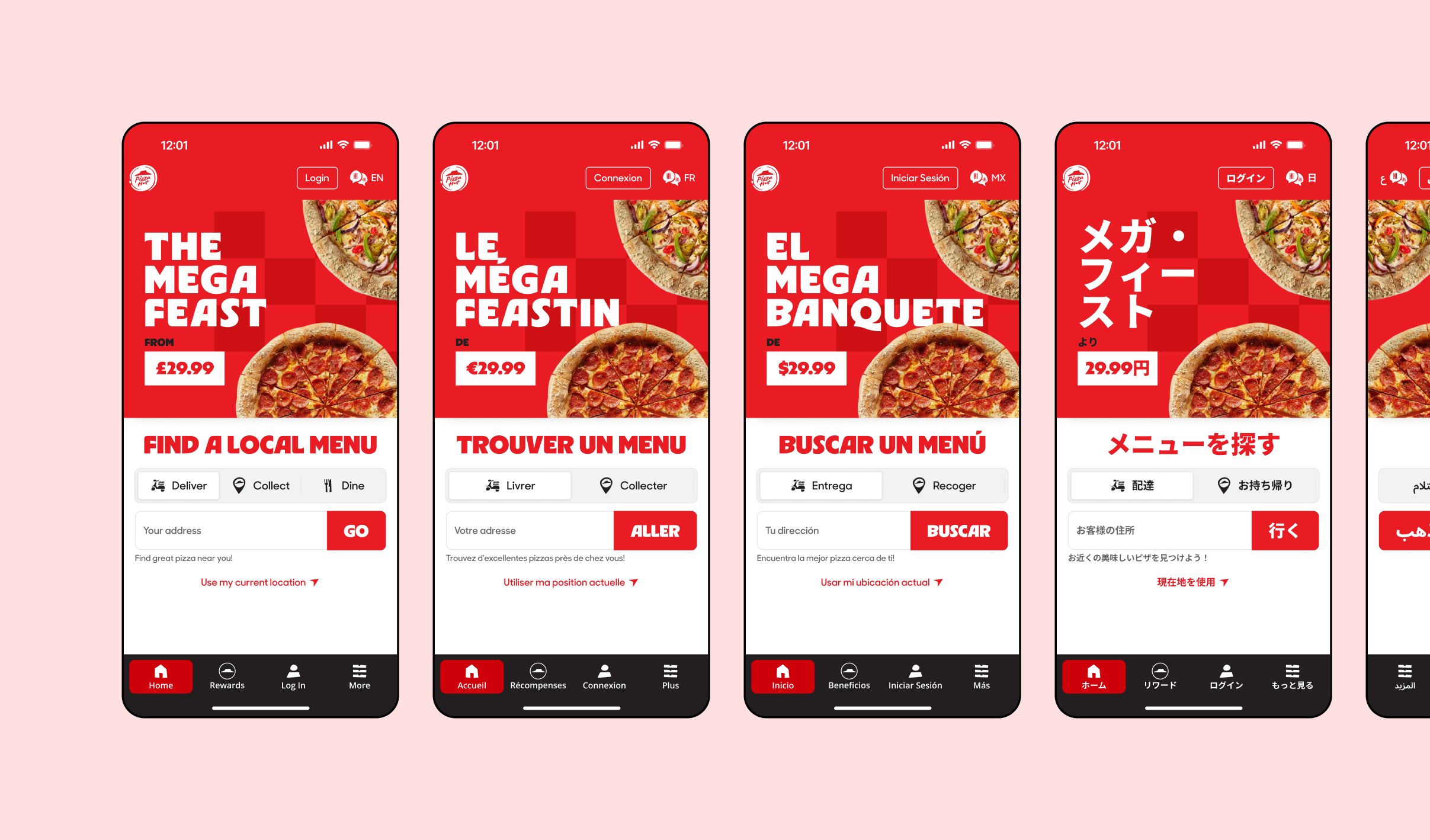
Brought into a new discovery team to lead with a design-first approach. My job was to keep the user at the heart of scoping and definition tasks, ensuring engineering constraints weren’t dictating of influencing the experience layer usability goals.
Problem
The implementation teams were under a lot of pressure, often having to uncover complex market requirements on the fly while trying to hit delivery dates. Unsurprisingly, this led to bloated timelines and features that didn't quite hit the mark. By taking on the discovery work upfront, I was able to give them the clarity they needed to build solid, scalable solutions without the guesswork.
My role
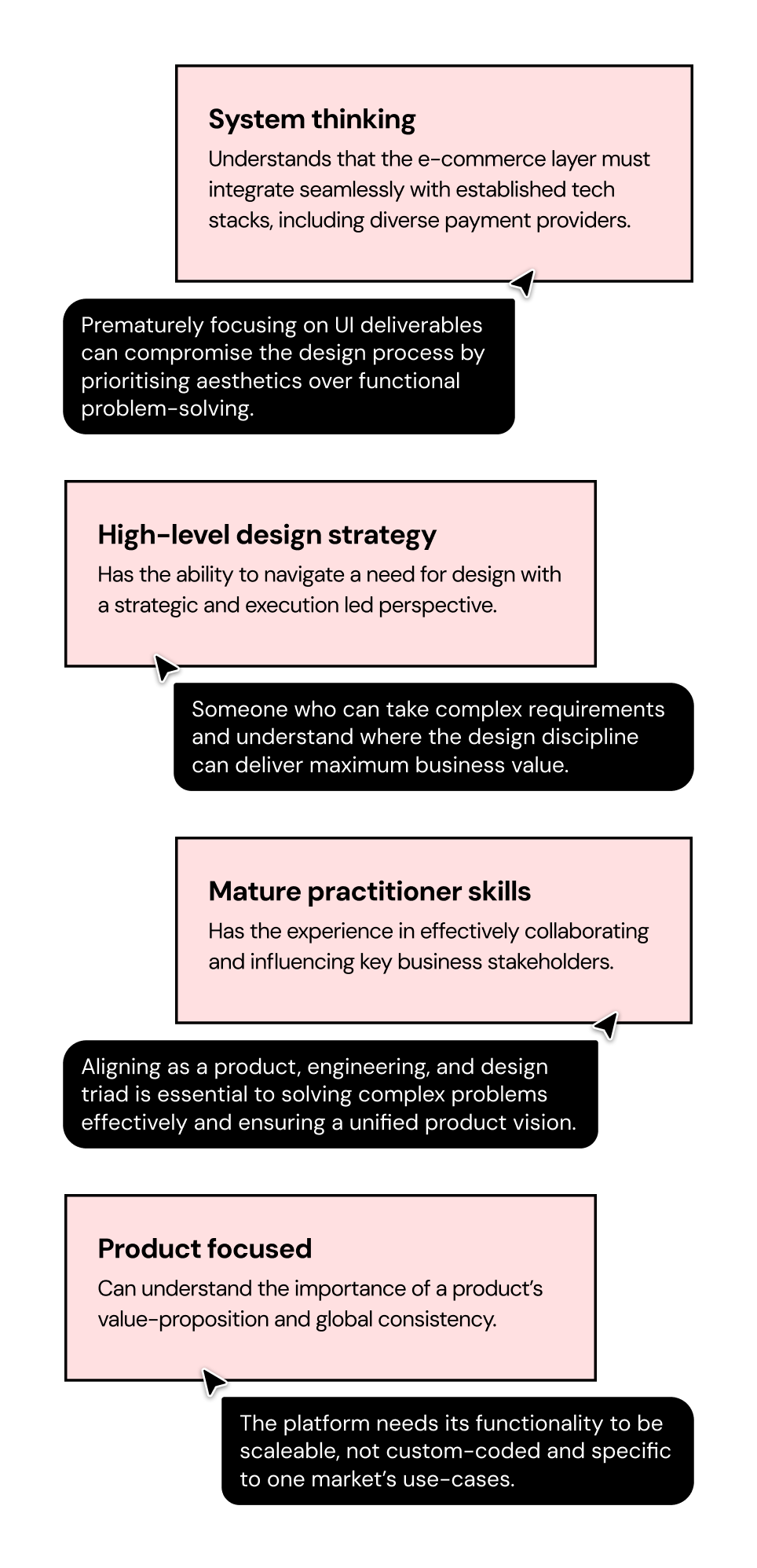
This role within the discovery squad required an experienced designer, one that had the following attributes…
Systems thinking - Someone who can effectively shift the focus from individual products or screens to the broader ecosystem in which those products live.
High-level design strategy - Someone who can operate at the intersection of strategy and execution. Rather than focusing solely on the visual aesthetics of a single interface, they look at how design can solve broad, complex problems.
Mature practitioner skills - Someone who has experience influencing stakeholders with data, key emotional intelligence and solid judgement, to help them focus on doing the right work that is key to the project success.
Product focused - Someone who can view their work through a business-viability and market-fit lens and how to contribute to a product’s value-proposition and long-term business goals.
More than anything, I was required to demonstrate how the function of design could be a key strategic-partner to product and engineering, not just a facilitation to delivery.
Market discovery
Business goal
The mission was to map out each market’s experience to identify where it was lagging and demonstrate the value of our platform to ensure that the project implementations increased key conversion metrics, not negatively impact them.
In action
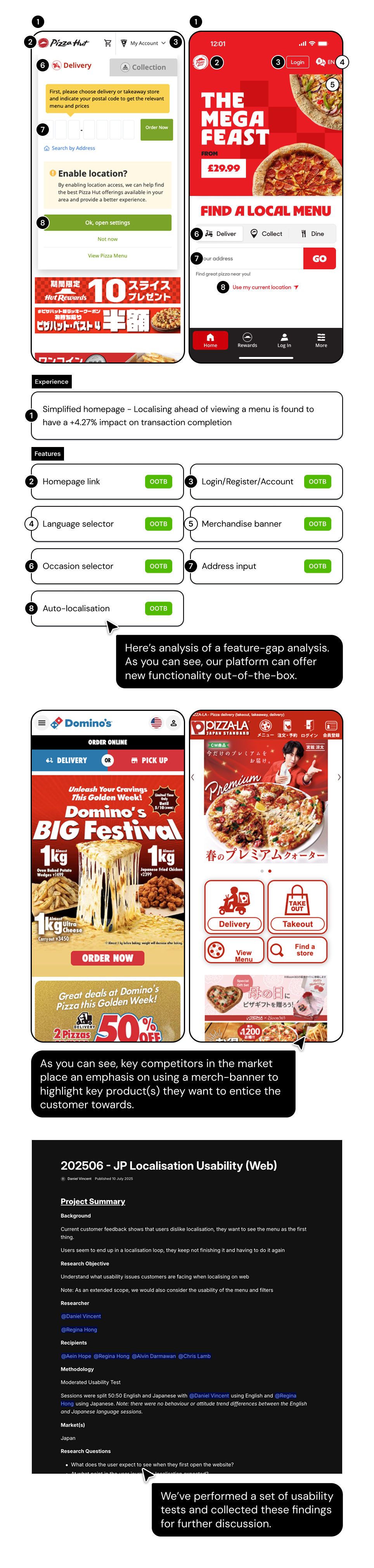
Before opening up a dialogue with the local market teams, I would perform a deep-analysis into their current experience. I wanted to understand where clear experience gaps existed, so I could present them with a clear experience-based plan that highlighted the parts of our platform that could help them hit the ground running without a lot of extra development effort.
The current market offering - I wanted to understand how our global feature-set translated to their current digital offering. By auditing their current experience, I could see which use-cases were already covered and which ones were being left behind. It gave me a great starting point for our discussions, as I could point to specific opportunities where we were adding key conversion value to other markets.
Key competition - I wanted to understand where the market’s offering stood when compared to their key competitors. This helped me pinpoint the areas where they were lagging in terms of features and—more importantly—show how our platform could help them leapfrog the competition by solving problems they hadn't even touched yet.
Selling the value proposition
The first call with the market is about much more than just a project kickoff—it’s about building a real sense of trust. I want to show the local team that we aren’t there to just push a global agenda, but to act as their strategic partners. The goal was to prove that every plan we made was designed to help their specific market thrive.
To make sure we hit that mark from a design perspective, I will…
Present findings - I’ll walk the team through what I found during the audit and competitive review. The goal is to zero in on the 'big wins'—those specific areas where we know our platform can step in and make the experience significantly better for their customers right away.
Story-tell with key data - I want to lead with what the customers are actually telling us. By sharing the results of our end-to-end testing, I can point to the exact moments where people are getting stuck. It’s a great way to validate the team's existing hunches while uncovering new issues that might have been flying under the radar.
Sell the experience - I’ll walk the team through a live demo of the experience, showing them exactly how their customers will move through the journey. It’s the best way to bridge the gap between a list of features in a catalog and a service that actually feels great to use.
Ultimately, we as a discovery team want the market to walk away from this call feeling genuinely excited about the path forward. The goal is to give them the confidence to say 'yes' to the discovery plan and get them on board for some in-person workshops and market visits.
Market visits
Building confidence
Video calls are great for check-ins, but they can only take us so far. By physically visiting the market for a few days of dedicated workshop sessions, we can cut through the digital noise. It gives me the space to focus entirely on the nuances of their experience and uncover the insights that usually get lost in translation across time zones.
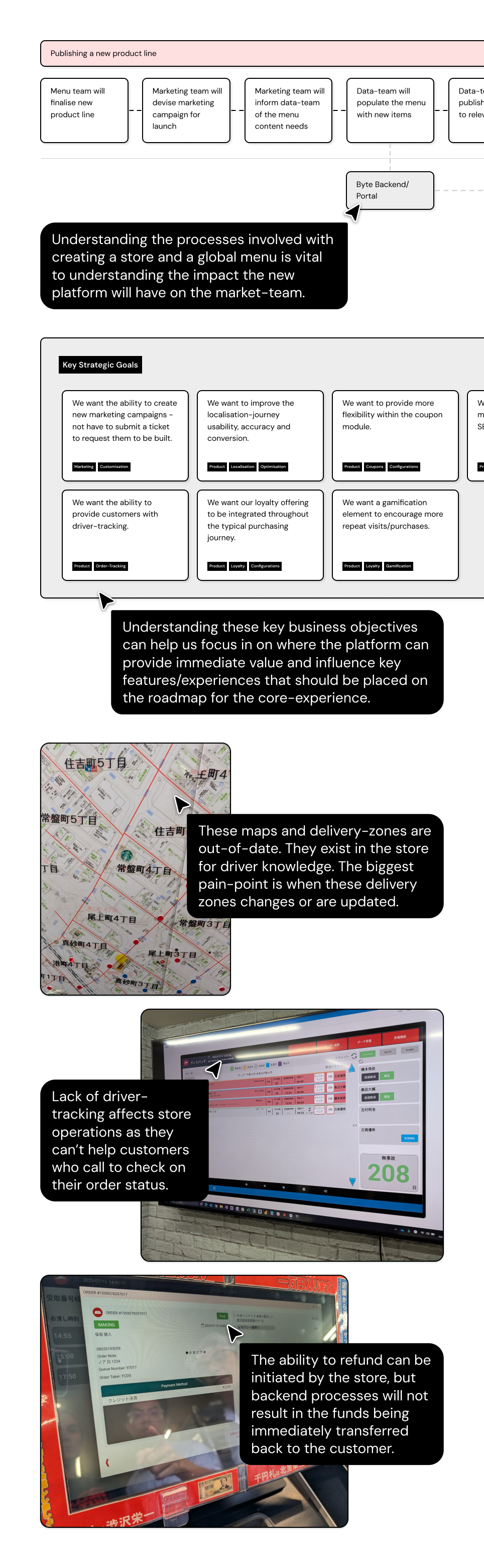
Business operations - I want to map out the 'day in the life' of the staff using these systems. Having everyone in the room allows me to look past the technical specs and see the real-world processes—helping me identify exactly where the current software stack aligns with their needs and where it creates friction for the franchisees.
Key use-cases - It’s vital to understand the history behind local variations. If a market has a different way of doing things, I want to know what influenced that decision. Was it a specific customer behaviour or a business requirement we haven't seen elsewhere? Understanding that context helps us decide if we should lean into their approach or offer a better global alternative.
Technological influences - It’s important for me to understand the technical 'why' behind the current experience. I want to see what limitations the team has been working around so I can show them how our new platform can remove those roadblocks and actually make their technology work harder for the user.
Market-goals - While reducing overhead is a clear benefit, I want to dig deeper into what success looks like for the market over the next twelve months. Understanding their core e-commerce and business goals allows us to tailor the experience to meet those needs. It’s about making sure our platform is a tool for their growth, while also helping us prioritise what we build next.
Store visits
To really understand the service, you have to go to the source. By visiting the stores, I can understand how the tech-stack aligns with the chaos of a kitchen. These visits are vital for validating that the 'view from the top' at HQ matches the reality on the ground. It ensures our designs are user-centric and truly support the restaurant staff.
Beyond the free pizza, I'm there to observe and ask the staff key questions about their processes…
Order scheduling - Visiting during peak hours is the only way to truly understand order scheduling. I'm looking to understand how the software serves the staff operationally during their busiest moments. My goal is to ensure that the internal workflow is smooth enough that the customer gets accurate, real-time updates on their screen without adding extra stress to the team on the ground.
Order issues - I want to get a first-hand look at what happens when things go wrong. Since the current platform leaves order issues for the restaurant to solve, I’ll run test scenarios in-store to measure the impact on the staff. It’s about understanding the 'cost of a mistake'—if a refund takes five minutes of a manager's time during a rush, that’s a failure we need to address in our interaction design.
Delivery operations - I’m looking to get a better handle on the logistics of the delivery trade zones. Because capacity is limited by the number of drivers on shift, I need to see how that reality affects the order flow. By understanding these 'ground truths,' I can design an e-commerce layer that reflects real-time statuses—ensuring we never promise a delivery time that the restaurant can’t actually meet.
Outcomes
The visit is about moving from 'discovery' to 'delivery.' We’re looking for that formal commitment from market leadership to move forward with the rollout.
Once we have that buy-in, my focus shifts to creating a rock-solid documentation package that contains all the insights I’ve gathered that will influence and impact the experience layer. I want to make sure the transition is seamless, giving the assigned project team and their designer a clear roadmap that justifies our timelines and keeps everyone aligned as we start building.
Project handover
Documenting decisions
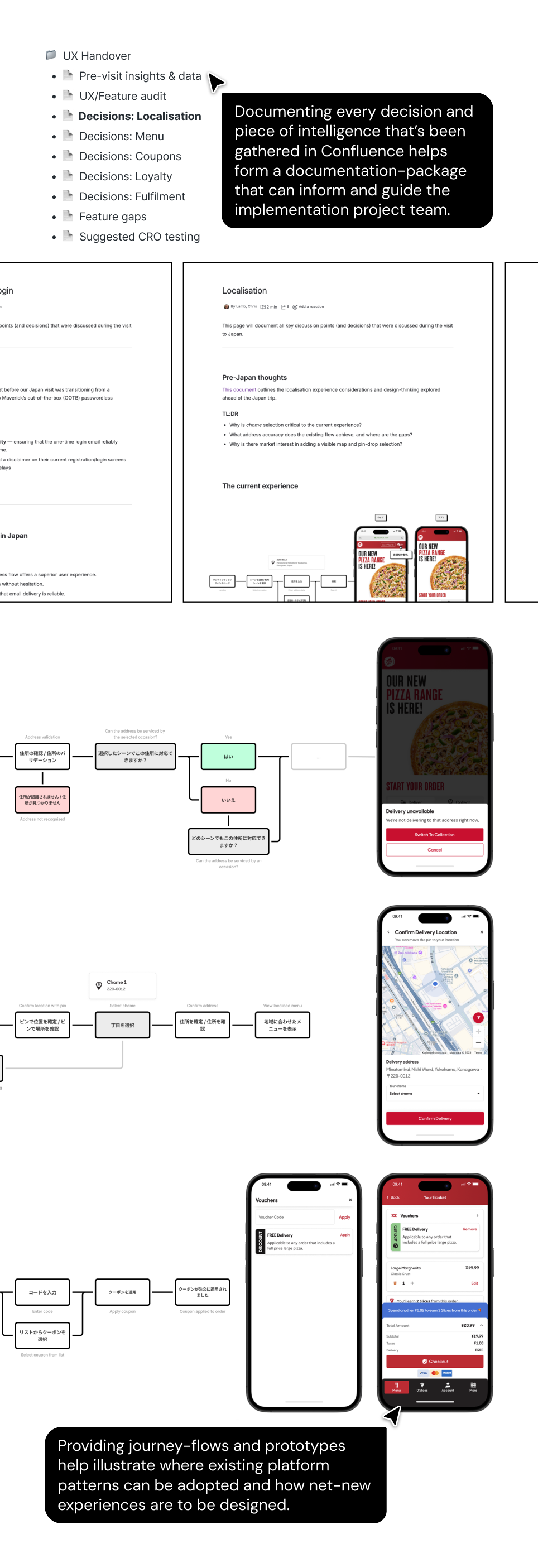
Discovery is only successful if the findings are easy to digest and act on. I see my role as a translator—taking everything we’ve learned from the market and turning it into a documentation package that the implementation team can actually use. I want to remove the guesswork so they can focus on high-quality delivery.
As part of my documentation package, I will include…
Service maps - I'll create a high-quality service map to act as the blueprint for the project. This will show the end-to-end experience, specifically highlighting where our digital platforms hand off to the restaurant staff. It’s the best way to ensure everyone understands how the tech supports the physical service on the ground and how those needs can be translated into the e-commerce layer.
Confluence documentation - I use Confluence to build out a central 'source of truth' for the project. It’s where I’ll document every key discussion and insight that impacts our front-end layer. By capturing these nuances clearly, I can make sure that as we adapt to the market’s needs, we’re still protecting our global design patterns and maintaining consistency across the board.
High-level design prototypes - While my goal is to stick to our established global patterns to ensure scalability, sometimes a market's unique needs require something brand new. In those cases, I’ll document the new interaction pattern alongside the specific business insights that triggered it. This ensures that any 'net-new' feature isn't just a one-off, but a well-reasoned configuration that can benefit the entire global platform.
Testing plans - If a market is worried that a global pattern might hurt their local performance, I don't just ask them to take my word for it. I build out a formal testing plan to put those concerns to the test. By setting a clear cadence for research and validation, we can satisfy the market’s 'anxiety levels' with hard evidence, ensuring the patterns we adopt are actually optimising the experience for their specific users.
Project support
Success in an agile environment means staying connected. I’ll be a constant presence for the project manager and design team, checking in during every sprint to help navigate any gray areas. If new influences or limitations pop up mid-project, I’ll act as the bridge to find a fix, ensuring the team stays on track and the project maintains the high standards we set during discovery.
Outcomes and reflections
The real value of our discovery work is the collaborative partnership it creates. By involving the markets early, we ensure they feel true ownership of the platform. We’re giving them a tool that is deeply aligned with their e-commerce goals and built to drive performance.
Some of the key positives I’ve taken away from my role within the discovery squad include...
I’m extremely proud of demonstrating how a design-led approach can actually protect business operations. By positioning design as a strategic partner, I helped improve both the efficiency and precision in project delivery deliverables. It’s no longer just about how the platform looks; it’s about how design thinking helps us navigate complex business goals and turn them into streamlined, effective digital services.
The data speaks for itself: as part of the discovery squad, we onboarded five new markets in just eight months. Before the squad was formed, it took 24 months just to onboard two. By introducing a structured discovery process, we achieved a 500% increase in efficiency, creating a sustainable pipeline of work that allowed the delivery teams to move faster and with more confidence than ever before.
From a personal perspective…
Leading the design narrative in software sales forced me to bridge the gap between user needs and business goals. This experience helped me transition into a lead-level mindset, where I’m not just managing tasks, but championing a user-centered philosophy across the organization. I’ve seen firsthand how this approach streamlines project efficiency and delivers measurable value to the business.
Success for me meant ensuring the delivery teams were set up for efficiency. I held my work accountable to the project’s delivery timelines, using onboarding speed as the key metric. Seeing the timeline shrink while we scaled to five new markets in eight months confirmed that our discovery process didn't just improve the user experience—it was undeniable proof that a design-led approach is a massive force multiplier for global business growth.
The discovery framework I built wasn't just for onboarding—it was designed to be modular and transferable to any net-new feature definition. Whenever the business identified the need for a new piece of core functionality, I led design-thinking sessions to map out both the immediate MVP and the long-term 'North Star' vision. This ensured we were always building with a clear purpose, balancing quick wins with a scalable future.